Tuesday, November 4, 2014

Microphone or Preamp? Which to Budget More For

So you are looking to beef up your home studio by adding a new microphone and preamp combination.   Now let's say you have a budget of $4,000 to put towards the pair.  You begin to search all the websites and catalogs, but you keep coming back to the same question: Which should I spend more on? The mic or the preamp?  In this post we will explore the pros and cons of each scenario that should provide some good direction when purchasing.  So let's begin.

Like always the results depend on what you are trying to accomplish with the new equipment.  So in our hypothetical example let's say we want an all-around studio mic that can produce crisp, clear sounds.  We also want a preamp that can provide a good signal to noise ratio and does dirty the signal.  So what's the answer?  Well in short, you want to spend more on the preamp than on the microphone.  There are exceptions to this, so let's dive a little deeper into the reasoning behind these answers.

The microphone comes first in the signal chain, and is the first thing that captures the source.  So it is important to have a good quality microphone that properly captures the source content and its nuances.  However, plugging a $2,000 microphone into a $200 preamp will degrade the quality of the signal.  A cheap preamp is more likely to add noise to your signal and even shave off some of the harmonic content through signal loss.  It may also yield a flat, dull sound.  So what's the point of having such a great microphone if the signal is getting destroyed by a cheap preamp?  If you haven't figured it out yet, the goal is to find a nice balance between the two costs that fits your own needs. This doesn't necessarily mean to split your budget and spend half on the mic and half on the preamp; although it could be a good place to start. 

When researching microphone and preamp options carefully read reviews and look at popular combinations that people are already using.  If you are looking to pair a microphone with an interface with multiple mic preamps, then read the specifications to check the quality of those preamps.  There are many great microphones that fall into the affordable range.  Purchasing one of those will leave you with enough to buy a decent preamp to pair it with.  This will give you a killer combo to capture some great sounds. Just remember that the preamp is more important, but don't let the cost gap between the too get too big.  A great preamp won't make a crappy mic worse, but it won't necessarily make it better either.  I bad preamp will almost always make a good mic worse.   Do your research, read the reviews, and compare various combinations until you find a good balance of cost to quality.  

Sunday, December 15, 2013

Wireless Media Technology: An Introduction To The Tech of Today

     By now you have the words "Apple TV" and "Chromecast" thrown around on the Internet and in everyday conversation.  These technologies are great solutions for the residential environment, but what about the professional one?  Wireless presentation has been a sought after goal for some time, and recently there have been some products released that offer some great capabilities.  These professional level products offer things that consumer products don't, and they each have their own niche.  This post is going to describe the technology and highlight some of the main contenders.

     Professional wireless presentation technology allows users to walk into a room and present from their laptop, tablet, or smartphone without the use of cables.  There are many different flavors of wireless presentation.  Some are catered towards presentation, while others are more for collaboration.  These professional versions of wireless tech is secured and dedicated so the content shared is protected.  This is something that the consume level devices cannot do.  It is for this reason that consultants hate putting consumer level presentation devices in large-scale professional environments.  Let's take a look at some examples.

Crestron Air Media:

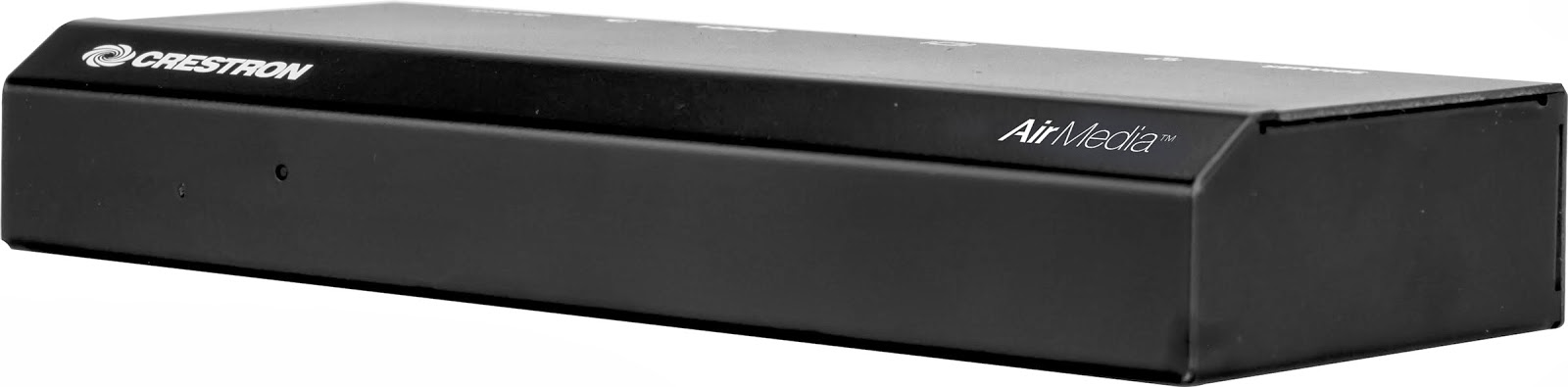
First up is Air Media by Crestron.  This device is very similar to the Apple TV.  The device connects to the display and allows the user to wirelessly stream content.  The difference is that the Air Media device uses your company's wireless network access points, so it is very easy to integrate.  The device is also more secure.


AMX Enzo:

Next is Enzo by AMX.  This device is focused around collaboration.  It works in a similar way to Air Media, but allows you to access various cloud clients from the device itself.  So you can pull up your Dropbox account and share the presentation.  Enzo also allows the presenter to share the presentation with those in attendance.  No longer does the presenter have to gather emails and send the presentation at a later time.  Instead, a QR code appears on the screen and each person can scan the code to get a copy of the content.

Crestron and AMX are the top two contenders in the professional wireless presentation arena with new ones popping up.  This market has been a need for a long time in the professional realm and it is great to see manufacturers taking it seriously.  It's also great that each manufacturer offers their own flavor so there are multiple options depending on the type of project.  User needs have always been the driving factor in designing systems, and seeing these manufacturers coming out with unique products is definitely a breath of fresh air.

-Jon Owens, CTS

Tuesday, October 1, 2013

Home Recording Equipment Basics

     So you want to build up a home studio but don’t know what to buy?  You have money to spend but no clue how to spend it?  Well thankfully, this post is dedicated to home studio budgeting basics.  In this blog post I will discuss useful ways to spend that money and some common misconceptions that can keep you from spending more than you have to.  

Basic Equipment:   

  First let’s talk about what you need to get started.  A computer is key for smaller project studios.  Most home studios run off some sort of DAW software inside a computer.  With that being said let’s talk about software.  There are many options when it comes to DAWs.  There is Pro Tools, Logic, Cubase, Nuendo, and Cakewalk.  Those are the top level DAWs that are recommended by professionals.  There isn’t much difference between them in terms of functionality.  The difference comes down to the user interface and what you feel comfortable with.  So download some demos and try them out.  A common misconception is that you need a separate piece of software for various tasks.  For example, Pro Tools for audio tracks and Reason for digital music.  This is incorrect.  All the professional level DAWs can record audio and produce digital music.  You really only need one DAW.  Then you can purchase third party plugins and virtual instruments to beef up the capabilities of that software. So pick a DAW, and purchase a simple interface.  Something with 2-8 channels is acceptable for a small home studio.  This interface will allow you to record audio into your DAW.  
     The next thing you need is a microphone.  Purchasing thing an external preamp is not necessary right out of the gate but I get a lot of people asking about this.  They want to know what to spend more money on; a mic or a preamp.  A good preamp can make a bad mic sound decent, but a cruddy preamp will make an awesome mic sound like trash.  So it is always better to invest in clean preamps.  You can purchase a good preamp and then get a mid-level microphone.  That’s a winning combination right there.  A great budget mic is the Rode NT1A or the Blue Bluebird.  I have been using both of those for years and love their sound.  

What about monitoring?

     The last piece of basic equipment you need is something to monitor with.  So get yourself some speakers or headphones.  When it comes to headphones you want as flat of a frequency response as possible.  This means NO BEATS HEADPHONES!!!  Beats headphones emphasize the lower frequencies and boost some highs, so this makes them terrible for mixing.  You want headphones or speakers that will give a good representation of the audio as it sits in the mix.  So shop around and make sure to look at the response curves in the specifications.

     So hopefully you now have some idea of the basic equipment you need to get your home studio up and running.  Some next steps may include buying plugins, virtual instruments, more microphones, or external gear.  As always, have fun with it.


-Jon


Sources:

http://bluemic.com/bluebird/
http://www.rodemic.com/mics/nt1-a
http://lifehacker.com/5853193/how-can-i-set-up-a-home-recording-studio-on-the-cheap
http://www.dummies.com/how-to/content/determining-what-you-need-for-your-home-recording-.html

Monday, September 9, 2013

Home Studio Acoustics: Part 2

     In the last post I discussed home studio acoustics and ways to improve the quality of your listening environment.  In this continuation I will talk about home studio sound isolation solutions to help keep sound from leaking into your neighbor’s place.  First, the basics of sound isolation.  Sound will ALWAYS find a way through openings.  Any opening, big or small, will let sound pass through.  Sound will also travel through the structure of the wall by vibrating the surface and passing those vibrations to the opposite side.  Three things happen when sound hits a surface.  Some of the energy is reflected, some is absorbed, and some is transferred.  We have already covered reflection and absorption, so onto transference.
    The most obvious place to start is at the door.  The quality of the door is going to make a huge difference in the isolation of the room.  Hollow core doors will let more sound through while solid core doors will absorb and reflect more.  So if you can, try to buy a nice solid door.  The next step is seal around the edges of the door.  You can buy standard seals from a hardware store and install it along the jamb of the door.  When the doors closes it will create a nice seal.  Next is to get a threshold seal for the bottom of the door.  Something along the lines of a standard bubble seal should suffice.  This will stop sound from escaping under the door.  
     

     Next is to find other places where sound can get into the wall or outside of the room.  Such locations include power outlets.  By taking off the faceplate you will notice a gap between the back box and the drywall.  Placing some sealant in this gap will stop sound from escaping.  So where else can sound get out?
     If you have a drop ceiling then chances are sound is escaping from there.  Special acoustic ceiling can be purchased that will not only increase the isolation, but the absorption as well.  If you can’t afford ceiling tiles then placing some insulation above the ceiling will work too.  Now just keep looking for places where sound can escape and do your best to seal up those exits.  Many people have asked me how to improve their walls.  If you have think walls that are bad at isolating sound, then it is best to rebuild the wall to be more resilient.  Using dual layer drywall or mass loaded vinyl is an excellent way to improve the performance of your walls.  Gaps in the fiberglass insulation can let sound through so using sprayed insulation will drastically improve your performance.  It will also save you money on the heating bill!  If you live in an apartment and can’t open your walls to fix them, then there isn’t much you can do.  The best solution is to try and place absorption and diffusion on the wall to catch as much sound to keep it from transferring through the wall.  Keep in mind that more absorption will alter the acoustics inside the room so use with caution.
    
     This concludes the two-part segment on home studio acoustics.  Stay tuned for future posts that will revisit some things in more detail.  Please do some research on your own and familiarize yourself with basic small room acoustics.  It will really help you during the treatment process.  Thanks for reading!


-Jon    

Wednesday, September 4, 2013

Home Studio Acoustics: Part 1

     We already know that home studios are not going away.  It is best to embrace this shift in the recording industry and figure out a way to make it work.  Many professionals criticize homes studios because they are often run by amateurs, and they don’t necessarily use the best equipment or have the best acoustics.  Recording and mixing music is all about the acoustics.  If the acoustics of the space are decent then low grade equipment can still be useful.  However, bad acoustics can make even the best equipment completely useless.  This two-part blog post will overview some effective ways to strengthen your room’s acoustics and give you a better mixing environment as a result.  In this first post we will go over some ways to treat the inside of your room.
     Let’s assume that for this post that you live in a space where knocking down the walls and building from scratch is not an option.  This is probably the most realistic scenario.  So what do you do?  Well, you have to treat the room in such a way that you eliminate reflections and room resonances.  However, sound isolation is also very important if you live in an apartment building and have neighbors.  Sound isolation techniques will be covered in the second post so let’s focus on reflections and resonances for now.  Small rooms are very tricky to deal with because they produce room modes within the audible frequency spectrum.  A room mode is the natural resonance frequency of a room dimension.  The equation is the speed of sound/wavelength.  The wavelength in this case is the dimension of the room.  So if our dimension is 19ft, then our resonance frequency is 1130/19=60Hz.  This means that we will have issues within the 60Hz area and some multiples.  
     These resonant frequencies will alter your perception of the mix and this can result in unbalanced mixes.  Reflections are another key component to small room acoustics.  Since the dimensions are shorter the reflected sound arrives at the listening position with strong amounts of energy. This too can alter the perception of the mix and cause phase issues.  So let’s talk about some effective ways to treat these issues.


     After figuring out the frequencies that are giving you trouble you can begin to pick out some acoustic treatments.  Companies like Primacoustics and Auralex provide some affordable consumer grade acoustic treatments that can get the job done.  Don’t just slap foam all over the walls though.  Place some absorption directly on the wall behind the speakers and at early reflection points to eliminate sound reflecting off the walls towards your ears.  Next, it is wise to pick out some diffusion to place on the wall behind the listening position.  This will help scatter the sound around the room so it does not create a standing wave.  A cost effective way to create diffusion is to use furniture elements like a book shelf filled with books.  The various depths and densities of each book create a great diffusion element with some absorption as well.  
     Everything I have discussed so far is great for mid to high frequencies, but we know that low frequencies are what’s giving us the most trouble.  Low frequencies like to hangout in corners so placing high density objects there can help absorb some low end.  The companies mentioned before also sell some corner bass traps to help with this problem, but it is not necessary to spend a lot of money.  You just have to understand basic acoustics and absorption properties.  Many people will say to place egg cartons on the wall for diffusion and absorption.  This is not a good technique.  Egg cartons do provide some absorption, but it is only in the high frequencies.  We know that small room suffer most from low frequency issues, so egg cartons aren’t the best solution.  
     This ends this installment of home studio acoustic basics.  Next post I will discuss sound isolation methods for your home space.  Future posts will revisit the acoustic treatment topic so stay tuned. 

-Jon          

Sunday, July 28, 2013

Control Systems - The Future Is Here

     The last post touched on the ability to monitor and control devices through a network.  This post will begin to explain some of the control systems that exist and what they are capable of.  Understanding these systems can give you a better idea of where technology is going and how it can be used.  
     Let me start with an example that people have probably heard of.  It is called Phillips hue.  Hue is a set of light bulbs that can be control with a mobile device.  The bulbs connect to a bridge that then gets connected to a wireless router via network cabling.  With the bulbs now connected to the network, you can control them via a smart phone app.  The app can dim and brighten, turn on and off, and even set scenes.  You can set up a scene for watching movies where your kitchen lights are dim, and living room lights are off.  Just press the scene and the lights will automatically adjust.  
     I started with Hue because it is the most consumer friendly example.  While the consumer market is just getting to know control systems, the truth is they have been around for years in the commercial market.  The leaders are Crestron and AMX.  These companies create complex control systems for nearly every aspect of your space.  You can control lighting, shades, computers, displays, and audio systems.  Manufacturers are making their equipment controllable so any of these items can be controlled over one of these complex systems.  
     A control system allows a user to control their entire space from a thin control panel.  These control panels can be button or touchscreen and can be located in a surface or set on a table.  Control systems are very popular in offices and boardrooms.  A user can sit at the conference table and lower the shades, dim the lights, turn on the display, and select their input source for presentation.  Control systems are used in many other applications as well.  The hotel industry uses them in their rooms to control various functions.  Some institutions use control systems for simple uses like lighting or shade control.  No matter the application, control systems provide a classy and convenient way to control lighting, shading, and devices.  While Crestron and AMX provide systems for home use, more consumer-grade products are beginning to surface.  Soon households will have control systems running every aspect of their homes.  Some already do, but more will certainly follow.  

-Jon

Tuesday, July 9, 2013

Audio Networking: AV Meets IT

     The world of analog audio has been on its way out for some time, and digital audio has been moving in.  Now there is a new culprit entering the scene, and that's networking.  The integration of digital audio means audio networks can now gain massive territory.  To illustrate, I will paint scenario.  
     The old way of designing an audio system was through analog means.  There would be a mixing board with physical inputs, analog cabling routing to processors, and then an output to speakers.  This is one of the simplest forms of an audio system.  In the analog domain an audio network gets messy as it grows in size.  This is due to the cabling, power, and space requirements. 
        Today’s technology has taken the world of network routing, and applied it to audio system applications.  Think of how your Internet and corresponding devices are set up.  You have your router that grabs the Internet from your provider to supply to your household.  Then every device you want on the network connects to that router somehow; whether it is physically or wirelessly.  All of those connected devices can now talk to each other and the Internet.  So, now you can print wirelessly, connect to the Internet, and share files remotely with other computers in your household.  These are the basics of networking and now you can do it with audio systems.  
     Audio is starting to use the same blue Ethernet cable that is used for Internet networks.  Ethernet has the capability to carry more audio signals than an analog cable that can only carry one.  So already there is an advantage.  Manufacturers are also developing digital audio devices that have the capability to talk to one another intelligently.  Addresses are assigned to each device that is attached to the network and with little manipulation from the user; these devices can talk to each other.  This is called Audio over Ethernet (AoE).  More commonly you will see it described as a Cobranet or Dante system.  These are two common systems that allow audio over Ethernet at great speeds.  Another advantage of having audio devices on a network is the ability to control and monitor them remotely.  There are some brands that allow the end user to monitor and control a device from anywhere in the world through the Internet.  The manufacturer sets up a web portal that allows the user to log in to his/her device(s) and control or monitor.  This is huge because I have witnessed first-hand, times when the crew needed access to a piece of gear but didn’t have the authorization, and the only guy that did was not there.  Having network capabilities eliminates that problem from occurring, or at least greatly reduces it. 

     So hopefully you can start to see how much of an advantage it is to have audio systems set up in a network configuration.  It allows for more complex systems, reduction in cabling, and expansion of use.  However, these systems are far more complex to design and install.  This sums up my introduction to the world of networked audio.  There will be future posts delving deeper into the equipment and techniques used to design and operate these systems.  

-Jon

Saturday, May 11, 2013

Professional To Consumer: How The Recording Industry Has Shifted

     Let me paint a picture for you.  You are in a band and want to record an EP.  So you call around to professional recording studios until you find one you like.  You book the time and spend a few days in the studio tracking.  Then the engineer mixes the tracks and you get your finished product.  Now you have to build up to a release of the EP.  Finally after a long campaign, the consumer gets their hands on the music.  

     The scenario I just describe is that of the old model of the recording industry.  Recording and distributing music hardly goes through that process anymore.  Now don't get me wrong, there are still many labels and bands that prefer to work in this method and I applaud them for it.  However, the recording industry has been undergoing a major shift in recent years from a professional centric system, to a consumer centric one.  So what exactly does this mean?  Well let me explain it.  

     Since the dawn of digital recording the technology has been getting more compact and easy to use.  Now anyone with a laptop can record and mix music.  Since recording is more accessible and affordable than ever, it has caught the attention of the consumer market.  Consumers are now recording themselves and their own bands instead of paying to record at a professional studio.  Even though the quality if vastly different, the incentive of not having to pay loads of cash is appealing.  Since the demand for consumer recording has skyrocketed, it only makes sense that the manufacturers would follow that path.  Manufacturers like BLUE have halted their professional series microphones and focused on consumer grade products.  They have shifted their niche focus and opened up a whole new market in the process.  Many other companies have entered the market to just focus on the consumer.  IK Multimedia is a company that just makes products for mobile devices.  Their niche is the mobile industry and they have seen much success.  

     So to conclude, the recording industry has taken a major shift to the consumer market.  Since the technology is only getting more convenient, I don't see this trend fading anytime soon.  So if you are a professional in the recording industry it may be wise to think about how you can make this new shift work for you.  I have seen many professional studios close because they refused to shift their way of doing business to keep up with the current demand.  In a future post I will discuss ways that professionals int he industry can adapt to the changing business. 

-Jon

Monday, May 6, 2013

Mobile Devices in Acoustics

     There are many ways to get measurements for acoustic design.  The current and most known way is to lug around a large case of equipment.  This is can be tiresome and costly if travelling by air.  This case usually consists of equipment necessary for room analysis and measurement.  A consultant would go into the space, set up the equipment, and take some impulse measurements to be analyzed back in the office.  These measurements help give the consultant an idea of how sound is behaving in the space.  They are a critical step in the design an consulting process.  So if this is such an important step, then how come people are still lugging around huge cases of equipment?  Shouldn't there be a better way by now?        

     Well, there short answer is yes, there are more convenient ways.  However, many professionals prefer to use the case of gear because the portable methods have not yet proven their reliability.  In this post I will discuss some of the more convenient methods that acousticians can use to conduct room analyses, and why some still prefer the old methods. 

     Before I dive into the discussion, take a moment to watch the following video from Apple's website.  It shows how some consulting companies are using Apple products to conduct room analysis and other on-site operations.  

http://www.apple.com/ipad/business/profiles/theatre-consultants-collaborative/

     As seen in the video, iPad can replace that entire case of equipment.  There are apps in the App Store that can be used to take measurements for acoustic and AV consulting work.  As with different pieces of gear, the apps have different calibrations and may differ from each other in accuracy of measurements.  This is where reviews and testing of free versions come in handy.  These apps pose a great use of mobile and tablet technology.  Here is a list of some of the more popular apps for consultants.

AudioTools
AutoCAD WS
Audio Tool
RTA

     Some professionals are skeptical when it comes to using mobile technology to take important measurements that are critical to the project.  From my discussions with professionals in the industry, it comes down to the accuracy of the apps, and the filters put in place on the input jack for these devices.  Professionals usually use high quality microphones and high quality interfaces to conduct their measurements.  It is this that causes them to be skeptical because mobile devices use filters and limiters on their inputs that may not be up to par with the high quality interfaces.  There are some solutions to this problem that are starting to ease the transition into a more mobile work environment.  

     There are a number of products on the market that are high quality microphones designed for iPad and iPhone.  This allows the user to bypass the built in microphone to get better quality measurements.  There are even some iPad interfaces that help to compensate for any filtering and limiting by using the charge port instead of the 1/8" headphone jack.  I have seen professionals use these items for quick measurements in situations where they just needed a rough reading and nothing too specific.  However, for important measurements to be analyzed and included in reports, they still turn to their case.  I think that the industry is slowly transitioning and once mobile devices have proved their results, then more people will start to ditch their bulky cases for a sleeker, more efficient approach.

-Jon         

Friday, April 26, 2013

The Acoustical Society of America (ASA)

     In the acoustics industry there is an association that every professional and student should be a part of or at least made aware.  This association is the Acoustical Society of America.  The ASA is the national group for all professionals and students in the industry.  So let's talk a little bit about what the ASA does and why you may want to join.

     The ASA is an association aimed to bring together professionals and students in the industry to help provide and guidance, resources. and networking opportunities.  They hold meetings and seminars that allow everyone involved to get together and network while learning something about the current industry trends.  So if you are in an acoustics related profession, why should you join? Wellllll...

     Let's start with their website.  The ASA site houses an abundance of resources that can be accessed.  Journals, periodicals, textbooks, research papers, and more can all be accessed and downloaded.  To me this is reason enough to join.  If you are a student in an acoustics related program then the resources that the ASA provides are very valuable.  The website has a list of grad programs around the country and contact information.  This is huge for someone looking for a good grad school.  There is also a forum that members can access to discuss topics and get advice about career aspirations.  The ASA website serves as a hub for all things acoustic in the country.  There are links to organizations, companies, and even job postings.  

Being a part of this organization is such a great asset to have.  There are so many ways to grow your professional network.  You can start discussions with people, ask or give advice, and attend the events to network in person.  The ASA provides ways for young professionals to gain exposure in the industry, and for veteran professionals to share their knowledge.  So to wrap things up, if you are a professional and you do anything with acoustics, then the ASA is a must join!

-Jon    

Tuesday, March 26, 2013

Music: Need or Want?

     What is a need?  Well, a need is something that promotes our survival like food, water, sleep, etc.  So, is music a need?  Many people consider music a want because they can't see how it is essential for us as a culture and as individuals.  Music is actually a need.  We as a society need music in our lives.  We also need music for our individual health and growth.  This ARTICLE has some great insight to the effects of music on culture.  

     Music in the most basic way is used as an identifier. Music can pinpoint a specific historical period, a location on the globe, or a specific culture. Music is a need for cultural reasons because it is a form of artistic expression. However, it is so much more than that. Music has physiological impacts on the brain. It can be used to actually make our brain feel certain emotions. Certain chords, intervals, instruments, and keys can be used to trigger emotional responses. This is part of the study of psycho-acoustics. Composers and sound designers use these tricks all the time in films to get the audience to feel for the characters and leave feeling emotionally invested.  Psycho-acoustics is a great subject about how we perceive and process sound.  I encourage you to read more about it.  Here is an ARTICLE that talks a little more about how different spaces can change how we perceive sound and music.  

     So we as individuals need music to help us internally. We use music in a therapeutic way to cope with emotion. We also use in tandem with emotions. For example, if we are feeling sad we may listen to sad music to help us express that emotion. The music we listen to has an impact on how we dress, how we speak, who we talk to, and even what type of career with we take. With music playing such a huge role in our individual and cultural development, it's hard to simply say that it is just a want and not a need. We all want to feel like we are a part of something larger than ourselves. At some point we all ponder about who we are as an individual. Music allows us to complete another piece of that puzzle and act as a conduit for cultural development. So the next time you are asked if music is a need or a want, you now know the answer.

Friday, February 15, 2013

The Subjectivity of Noise

     There is noise all around us.  City streets filled with roaring buses and people on their cell phones.  There is so much noise around us that we tend to ignore it.  Ignoring the noise does not make it go away. Noise pollution is often the last thing to be considered when designing a building.  Noise is considered to be any unwanted sound.  This definition is a bit subjective since everyone has different ideas of what can be categorized as unwanted sound.  Someone may say the sound of their neighbor banging away on drums at midnight is noise, while the drummer perceives it as music.  While the threshold of what delegates wanted from unwanted sound is blurry, there are many things that are considered noise in which society is in agreement.  Below is an amusing picture that helps to illustrate the subjectivity of noise.


The sign above states that "unnecessary noise is prohibited," but what constitutes unnecessary noise? This sign does not make sense because what is considered noise to someone may be pleasing to another.  And is there such a thing as necessary noise?  If noise is defined as unwanted sound then necessary noise would imply that it is in fact wanted, therefore contradicting the definition.  So all this sign does is produce a paradox.


     Noise pollution is a growing concern in the world today and before we can tackle this issue, we need to first define the types of noise that are polluting the environment. To do this we must look at the noise sources that society is in agreement. Such sources can include traffic, trains, rooftop HVAC units, and loud machinery. Noise sources are location based so in a school, noise can be the classroom next door being too loud. This is a noise source for students in the other class. They will have trouble paying attention and studying when noise from the class next door is being transmitted into their learning environment.

   The following LINK will show an article about rising noise levels in New York City.  The noise level are getting so bad that hearing loss is being caused over extended periods of time.  Exposure to high decibel levels for extended periods will cause hearing damage, and when the people of New York are experiencing 70dB and up for more than 8 hours a day it begins to take its toll. 

     Future blog posts will dive deeper into these various sources of noise as well as common methods of treatment.  For now, understand that the best way to treat noise is at the source.  Engineering said device to not emit strong noise levels is the best solution.  However, most of the time it's very expensive and time consuming to go this route.  Click HERE to see some information on types of noise and some common ways to treat them.  This will help to further explain what I have just talked about and also serve as a transition into future topics. 

-Jon Owens
Audio Engineer/Sound Designer/Acoustic-AV Consultant
www.jon-owens.com

Monday, January 30, 2012

Is Audio School The Best Choice?

In this post I am going to talk about whether or not audio school is the right path to take if you want to get into the audio industry. You will hear opinions praising both methods. I am going to approach those opinions unbiasley and let you decide which path is right for you. Then I'll give my opinion based on my own personal experiences.

Let's start with the School of Hard Knocks method. This method involves skipping formal audio school and diving into the industry head first. Many of the audio professionals from earlier generations did this method. They acquired an internship or mentorship and worked their way up from there. This is more of a learn as you go method. A lot of these professionals will argue that audio school doesn't teach you the real world experience that is needed in this industry. And that they just take your money and throw tests at you and don't teach you anything that you can't learn in the field as you go. While some of you may agree or disagree to this point, take that into consideration when deciding which path you want to take. Then there are those That favor audio programs and say learning as you go limits you to one area of the audio industry and that audio programs help to give a person a well rounded survey of the industry and allows the person to work in various fields of industry. So for example if you get an internship at a studio you are only learning what it takes to run and work a recording studio while all the other aspects of audio may not be learned, like live sound and all the science of sound.

Now for audio schools. Those in favor will say that audio schools help give students knowledge about a variety of jobs in the industry and allow the student to make better decisions. It also gives them a well rounded education and that extra knowledge may come in handy throughout their career. Almost any audio school professor will still say that an internship of some sort is needed to actually get your foot in the door. The school gives the student the tools to network and succeed but it is ultimately up to the student to do the leg work and make it happen. Then there are those that say going to an audio school is not needed and you can have the same level of success without it if you work hard enough. This may be true, but for some students they don't know what area they want to go in or how to do it so school provides them with knowledge and options to better make those decisions.

Now for my opinion. I personally think that both are important and it is possible to do well using both methods. It comes down to what area you what to go into and how much knowledge you care to have about the other aspects of the industry. If all you want to do is work in a recording studio and record bands then skip school and get an internship and learn that way. If you want to work in the science of sound like acoustics, then school is highly recommended although some have succeeded in this field without formal schooling. I went to school for two years and then got a mentorship at a recording studio. Through that I learned everything I needed to know about owning and operating a studio, but I wanted to know more about the industry and about the science of sound. So I went back to school to finish my degree. The school environment is a lot different than the intern environment. I mainly wanted to focus on the parts of audio I didn't know and the school helps me with that. It also opened my mind to parts of the audio industry I didn't know existed. Some of those are mentioned in my previous post. I think it's important for a person to be well rounded no matter what field you're going into. Knowing some physics and electronics helps alot when dealing with recording and mixing. Also completing school helps you be a better intern and employee. Knowing at least some of what it takes to mix and record is better than going in blind in my opinion. Real work experience is definitely needed and what you learn in school is rarely how it actually works in the real world, but the same principles can be applied. School let's you experiment and be creative so you can develop your own style and uniqueness that can be marketed to your benefit when searching for a job. I found that just learning how to record and mix wasn't enough for me, so I went back to school and haven't regretted it since. It is also important that if you do choose an audio school, you be active in the industry. Get out and network, shadow at recording sessions, do live sound for a local band. Do whatever you can to get some experience while at school. This will greatly help once you graduate as you will already have some real world experience and look more appealing to an employer. This will also help you apply the things you learn to the real world before you graduate and get you more real world ready.

So to sum up, there are two methods people can take when getting into the audio industry. I recommend schooling and then some sort of internship or mentorship. This gives you the tools you need to be successful and then a taste of real world experience to help get your foot in the door. I did mine in reverse. I did a mentorship and then went to school. I actually feel this is better because while I'm at school I can be working at the recording studio and freelancing. So based on what Ive said hopefully you can make a decision that best suits you.

-Jon

Monday, January 23, 2012

Making Money in the Audio Industry

     I'd like to start off by stating that these are just my opinions based on my experience and knowledge I have collected throughout my time in the industry thus far. I do not mean to offend anyone and in no way should my statements be taken as fact. If you are intrigued by something I say please feel free to do your own research and draw your own conclusion. And now, we're off!

     I always hear people saying that you can't make money in the audio industry. I hear this from students and pros alike. People say that you have to be constantly working and never sleeping, but they are only talking about a small sliver of the audio industry. In this blog I am going to go over a bunch of career opportunities that are different than the typical live sound or studio engineer roles people think of when they hear (pun not intended) audio industry.

     While these jobs may not be as glamorous as being an engineer, they are likely to be more stable and perhaps even pay better and be less stressful. So consider these as an alternative.

     It bugs me when people say you can't make a career out of audio. Think of a job and more than likely some sort of audio device is needed or involved in that job.  Someone also needed to install it, build it and maintain it. Well there's a job. You can make a career of installing and maintaining various audio system setups for churches, schools, and office buildings. All these places need someone who knows audio.

     Audio is a part of physics so any career that is physics based can have a need for audio experts. Like acoustics! There are many acoustic design firms that specialize in designing spaces for churches, theaters, auditoriums, conference rooms, and even recording studios. Nearly every space needs someone to do the math for the acoustics, and that could be you.  Another physics based career is doing sound proof testing for various pieces of machinery and vehicles.  Construction vehicles can't exceed a certain noise level, so someone needs to do the math to figure out how loud they are and how to quiet them down. Submarines need to be designed a certain way so the sonar works properly. These are audio careers that are outside the realm of art and more science based, but they pay good money and are reliable.

     Every audio person wants to be a big time live sound engineer or studio engineer. They tend to overlook the people that come before that. Some type of sound company needs to provide the equipment for the engineer to work with. There is always a need for sound companies. These companies provide sound and sometimes lighting equipment for seminars, concerts, weddings, trade shows, and more. Think of how many events get put on that need sound. Also in the live sound world someone needs to provide backline equipment like amps and guitars, as well as companies that repair music and audio equipment.

     Another market that is growing is video game music. Music and sound are becoming more and more important as video games become more like cinematic experiences. Game studios are beginning to hire in house sound and music people to cut costs on external studios. A lot of these game studios require you to know C++ programming which isn't very hard. So self learn and apply!

     Now some of you may be reading and thinking, "but I don't find the science of sound all that interesting." and I say to you, then why are you in the audio industry!? Audio is sound which is science.  If you are not interested in the science of sound then switch careers.  But...if you are thinking that you want a career that's more heavy in the art of audio and not the science then that's a different question.  With the growing affordability of audio gear and marketing towards the average consumer, a lot of people have no idea how to set up a home recording system or even what to buy.  Now, some professionals will say that home recording is killing the industry and not to endorse it, but those are all older professionals with an out of date way of thinking.  Home recording is here to stay and it's only going to get bigger, so you might as well accept it now and make the most of it.  One way you can take advantage of this growing market is to offer your services as an audio consultant.  I have gotten offers and calls from many people wanting to put together their own recording setup.  They don't know what to buy or how to hook it up and that's where I come in.  I take a trip to their place or they come to me and we discuss the details like, what are they using it for, what's the budget, how fancy they want to get, ease of use, etc.  Then I recommend some pieces of gear and they make the final decision based on my recommendations.  Then after they get it all I go back and install it for them.  Finally I explain to them how it's hooked up and how to operate it by going through a tutorial on everything.  Most of the time these people are musicians and know how sound and gear works so the basics of recording are already there. However; if they know nothing about recording but want a basic setup to record a guitar and vocals, I will give them a quick tutorial on the basics of recording and recommend some books to help them learn further.


    In summary all these jobs I have mentioned are great alternatives to being a sound engineer.  People may be right when they say that the need for sound engineers is dying, but the need for audio professionals is growing.  So based on what I've stated use your imagination and think of some other jobs that involve audio and try to find something that you will enjoy.  And you can still freelance as a recording engineer on the side, but at least you have that stable day job.  Thanks for reading and please post any other audio jobs you can think of.

-Jon